Tuesday, May 21, 2013

What's Next for my Team? Everything NBA Draft


The NBA combine was last week, and the lottery was just about an hour ago.  While personal workouts for teams still will help determine where guys will ultimately be going, having a compiled list of players, rankings, and draft position may help the fan in you figure out who your team should acquire.  For all combine results go to Draft Express for results from drills.  If you’d like a game-by-game breakdown of their collegiate career, visit Sports Reference.

Lottery Draft Position:
1) Cleveland Cavaliers
2) Orlando Magic
3) Washington Wizards
4) Charlotte Bobcats
5) Phoenix Suns
6) New Orleans Pelicans
7) Sacramento Kings
8) Detroit Pistons
9) Minnesota T'wolves
10) Portland Trailblazers
11) Philadelphia 76ers
12) Oklahoma City Thunder
13) Dallas Mavericks
14) Utah Jazz

*=Denotes Foreign player who did not play college basketball in United States

Top Ranked Players
Cody Zeller (PF/C)
Mason Plumlee (C)
Victor Oladipo (SG)
Ben McLemore (SG)
Alex Len (C)
Trey Burke (PG)
Shabazz Muhammed (SF)
Otto Porter Jr. (SF)
Nerlens Noel (C)
Anthony Nennett (PF)
*Dario Saric (Forward)

ACC Players
Reggie Bullock (UNC)
Mason Plumlee (DU)
Seth Curry (DU)
Erik Green (VT)
CJ Leslie (NCSU)
Lorenzo Brown (NCSU)
Richard Howell (NCSU)
Kenny Kadji (UM)

BREAKDOWN BY POSITION
Point Guards
Michael Carter-Williams (SYR)
Shane Larkin (UM)
Lorenzo Brown (NCSU)
Trey Burke (MICH)
Pierre Jackson (BAY)
*Dennis Schroeder (GER)
Peyton Siva (LOU)
Erick Green (VT)

This is an incredibly point guard rich draft.  It’s the deepest position in the league and it only looks like it will get deeper.  The top tier talent in this draft that has been universally classified as weak, but several teams could find a starter or rotation contributor in this pool of players.  Looking at the Final four teams in the NBA Draft, the point guard position is clearly a valued one.  Having someone to run your offense and be an extension of the head coach is vital when the possessions drop and points are more difficult to come by. 

Here, there are a variety of players and styles to choose from.  Michael Carter-Williams is arguably the player with the most upside out of the group, he left Syracuse as a sophomore and has the length (6’ 5”) to pressure and bother opposing guards.  In the game vs Michigan in the NCAA tournament his opposing guard (National Player of the Year Trey Burke) to 1/8 shooting on what was clearly his worst game of the tournament. Shane Larkin (who tested out as the best athlete at the position at the combine) is a combination of explosiveness and guile.  He’s a deadeye shooter from the perimeter (40% from three) and has experience running a talented team.  Larkin kept a talented UM team happy, perhaps he could do the same with a litany of stars.  As a projected late 1st round pick, would fit in perfectly with the LA Lakers.  He could learn under Steve Nash while playing heavy minutes to spell the vet over the course of the season.  Add to that his shooting ability to help space the floor for a couple of bigs, and Larkin would be a perfect fit for the team.

An intriguing prospect is combo guard Erick Green.  While he led the nation in points per game, he was also the leader in assists on the team.  Moreover, the Hokies were bottom-dwellers in the ACC and every defense keyed on him.  The fact that he was able to be successful with minimal talent surrounding him while being the focus of every opposition’s defense, speaks volumes about his ability.  Some scouts may be concerned that he isn’t a “traditional” point guard, but Green has insisted he scored simply because he was often the best option on an anemic offense.

My sleeper at this position is Lorenzo Brown. The point guard out of NC State is an intriguing prospect.  He has only played the position for two years, and is still learning.  But at 6’5” and superior court vision (Brown had 9 games of double digits assists), Brown can grow into the position.  Brown has shown a propensity for hard-nosed defense and, despite his average foot speed, could be a good perimeter defender immediately in the league with his size.

Shooting Guards
Ben McLemore (KU)
CJ McCullough (Lehigh)
Glen Rice Jr. (NBDL/GT)
Tim Hardaway Jr (Michigan)
Victor Oladipo (IU)

In the age of combo guards (Steph Curry, Derrick Rose, Russell Westbrook) CJ McCollum is arguably the best of the draft.  Before his foot injury sidelined him for the last half of the season, he was averaging nearly 24 points as the lead guard for Lehigh.  His personal workouts will be key, to see how healthy he is, and to see how he does against top competition.  Even with the success of Rookie of the Year Damian Lillard and Curry, teams may be hesitant to draft a guard from a smaller school that played lesser competition.

Glen Rice Jr. is an interesting case, specifically for his path to the draft.  After he finished at Georgia Tech, Rice went directly to the NBDL.  Because he is not yet 22, and had not gone through the draft process, Rice was eligible to be drafted.  Despite not getting much playing time early, Rice averaged 25 points per game in the finals of the Developmental League.  In a draft full of assets with question marks, Rice may be the closest thing to a sure bet.  He is already a professional, and the developmental league is considered a higher level of competition than college.  Rice is extremely athletic, and has shown the potential to be able to knock down his jump shot consistently.

The highest ceiling of this position belongs to either Ben McLemore or Victor Oladipo.  Freshman sensation McLemore had brilliant games this season at KU, going for 30+ points three times.  He’s an athletic 6’4” guard who finishes extremely well around the basket and can knock down the outside shot.  McLemore struggled on the road, and had some memorably bad games in the NCAA tournament when the level of competition ratcheted up.  But as a freshman, a lack of consistency won’t dampen his draft position much.  He has been projected as high as a number 2 pick going to the Bobcats.  Another rumored player the Bobcats could be targeting is Oladipo.  When he first came to IU he was a raw player from basketball factory Dematha high school.  Since then he has developed a competent offensive game and even a solid jumpshot to accompany his smothering defense.  His high ceiling is due more to his intense work ethic, than natural ability.  He has been compared to Dwyane Wade because of his size 6’ 4” and explosive leaping ability, as well as his defense and shot blocking prowess.  Wade’s handle was better, but the fact that the junior has worked so hard to improve over his tenure at IU is a comforting thought to general managers moving forward.

My sleeper for this position (indeed, this draft) is Tim Hardaway Jr.  At 6’6” he has good size and no gaping holes in his game.  Despite his poor postseason play, Hardaway has shown the ability to shoot, defend, and finish at the cup.  He impressed in workouts with his ability to create his own shot, as well.  Moreover, being the son of an accomplished NBA, Hardaway is keenly aware of the work ethic necessary to be a pro.  Previously picked to be as late as a second round pick, Hardaway’s combine scores impressed NBA decision-makers and could have him moving up draft boards.  It will be interesting how attractive this “safe” pick will be as we near the draft in June.


Centers
Nerlens Noel (UK)
Kelly Olynyck (GU)
Alex Len (UMD)
Gorgui Dieng (UL)
Cody Zeller (IU)
Mason Plumlee (DU)

Despite what pundits have been claiming as the death of the big man, three of the final four teams competing for an NBA championship have an All-Star caliber Center roaming their lanes.  The position hasn’t stopped being important, it’s just less glamorous than it used to be.  Perhaps that’s why Zeller has tried to repackage himself as a stretch four, and Plumlee was classified as a forward by ESPN despite playing exclusively at the center position during his career at Duke.

Dieng (who was recovering from a foot injury and did not participate in any physical drills at the combine) and Noel are considered the best defensive prospects at the position because of their length and ability to get to opponents’ shots.  Dieng has showed the ability to set the pick and knock down the free throw line jumper.  Noel is a defensive stalwart, but is still fairly raw offensively.

[Sidenote: Noel is in a VERY interesting position in terms of this draft.  With his ACL tear, he won’t be ready to play until around Christmas.  With the robust talent that will reportedly be available in the 2014 draft, there have been rumors that some teams would select Noel knowing that he would not contribute much next year, allowing the team to get back into the lottery.  Essentially, the line of thinking is that by selecting him (perhaps with the first pick in the draft) a team would be able to get two lottery picks in the upcoming drafts and really make a difference for a struggling team.]

You’ll hear the words “upside” and “potential” about a million times before the draft is done.  Alex Len could be the personification of those ideals.  A talented big from UMD, he has shown a penchant for scoring in the post.  Physically, he still needs to grow into his body and will probably struggle/see limited minutes in his first season.  But he made some headlines when he proclaimed that in a decade he’d be the best player that came from this draft.

On the opposite end of the “potential” conversation is Olynyck.  He stayed all four years at Gonzaga, and developed his body and game.  While he is no fantastic athlete, he is extremely skilled.  Moreover, with the success of Marc Gasol, he could become a quality defender despite never averaging more than a block a game.  He may be the safest pick further down in the draft.

Forwards
Otto Porter Jr. (GU)
*Dario Saric (Croatia)
Shabazz Muhammad (UCLA)
*Giannis Antelokuonmpo (G
Anthony Bennett (UNLV)
Cj Leslie (NCSU)
*Rudy Gobert (France)

The forward position is the most talent shallow of all the positions.  As with so many things NBA draft, the impact that these prospects will have depends on fit.  Otto Porter Jr. was the best out of the crop, and was far and away Georgetown’s best option.  He was a Naismith Player of the Year candidate most of the year.  The most striking part about his game wasn't his ability to score, but his passing ability.  None of his numbers will jump out as jaw dropping (16 points per game, 7.5 rebounds and 2.7 assists) because of GU’s style of play.  But if he were put in a position to work off ball (perhaps with the Cleveland Cavaliers and their two ball-dominant guards), he could aid a team immediately, while covering up his own deficiencies in creating his own shot and getting to the rim.

Shabazz Muhammad came into his freshman year as one of the top picks in this year’s drafts.  One of the most heralded HS players in the last decade came into his sole college season out of shape (due to injury) and didn’t impress early.  While he finished the season well (with averages of 17 points per game and 5 rebounds) he never displayed his former dominance that some scouts had predicted when he was first going to UCLA.  Adding to the detractors' ammunition was his addition to his age. It turned out that Muhammad was older than scouts previously thought and will be 21 once the NBA season starts despite only playing one year of collegiate basketball.

Anthony Bennett shows a lot of promise at the Power Forward position.  He is capable of putting the ball on the floor and driving to the basket.  He also played at the center position at times, and has the ability to score with his back to the basket.

Keep an eye on Kenny Kadji out of Miami.  He is older (25) but shot well from the position and looks to be NBA ready.  He isn't a great athlete, but shoots well outside for a big and played in an NBA-style offense with heavy pick and rolls.  Kadji is a projected late 1st/2nd round pick.  Given the right situation for a contender, he could thrive because of his ability to stretch the defense and allow his teammates to cut and drive to the basket. 

CJ Leslie has been the most mercurial talent in the country this year.  Leslie could be described as “Jack of all trades, master of none.”  He has a solid jumpshot, can create off the dribble, and (despite his wiry frame) has a good array of post moves. As multi-talented as he is, there were games where he seemed disinterested and completely withdrawn.  He reminds me a lot of Jeff Green when he came out of Georgetown; he, too, was prone to bouts of indecision and ineffectiveness early in his career. 


Here is a complete list of all of the participants of the NBA Combine. For a point of reference, 29 of the 30 top picks in last year’s NBA draft participated in the combine.

PLAYERS
·         Trevor Mbakwe (F-Minnesota)
·         Seth Curry (G-Duke)
·         Isaiah Canaan (G-Murray St.)
·         Jeff Withey (C-Kansas)
·         Kenny Kadji (F-Miami)
·         Mason Plumlee (F-Duke)
·         Ryan Kelly (F-Duke)
·         Glen Rice Jr (G-Georgia Tech)
·         Erick Green (G-Va. Tech)
·         Brandon Paul (G-Illinois)
·         Peyton Siva (G-Louisville)
·         Solomon Hill (F-Arizona)
·         Mike Muscala (F-Bucknell)
·         Erik Murphy (F-Florida)
·         Nate Wolters (G-S. Dakota St)
·         Kelly Olynyk (F-Gonzaga)
·         Carrick Felix (G-Ariz. St)
·         Allen Crabbe (G-California)
·         Andre Roberson (F-Colorado)
·         Ray McCallum (G-Detroit)
·         Victor Oladipo (G-Indiana)
·         Tim Hardaway Jr (G-Michigan)
·         Phil Pressey (G-Missouri)
·         Tony Snell (G-New Mexico)
·         Deshaun Thomas (F-Ohio St.)
·         Gorgui Dieng (C-Louisville)
·         Shane Larkin (G-Miami)
·         B.J. Young (G-Arkansas)
·         Pierre Jackson (G-Baylor)
·         Otto Porter (F-Georgetown)
·         Cody Zeller (F-Indiana)
·         Ben McLemore (G-Kansas)
·         James Ennis (G-Long Beach)
·         Alex Len (C-Maryland)
·         Adonis Thomas (F-Memphis)
·         Trey Burke (G-Michigan)
·         Myck Kabongo (G-Texas)
·         Steven Adams (C-Pittsburgh)
·         Ricky Ledo (G-Providence)
·         Nerlens Noel (F-Kentucky)
·         Archie Goodwin (G-Kentucky)
·         Grant Jerrett (F-Arizona)
Shabazz Muhammad (G-UCLA)

Monday, May 13, 2013

Jarrett Jack Crunches the Numbers

Jarrett Jack and Harrison Barnes carried the Warriors when they needed it most


Analyzing a team is a combination of art and science.  Despite my love of statistical analysis, I use them to support my thesis.  Metrics should mostly be used to research an existing idea that is ascertained from watching the game, not as the genesis for an idea for what ails a team.  No one embodies that idea more than Jarrett Jack.

The Warriors evened the series yesterday at 2 apiece as the Warriors vs Spurs series went into overtime for the second time on Sunday.  With Steph Curry ailing on a weak ankle and Klay Thompson struggling, the Warriors needed more perimeter offensive help early.  Along with Harrison Barnes’ contribution, Jack kept the Warriors in the game in the first half.  Despite being down by 10 points at the half, without his contribution the Warriors may have given the Spurs a lead that was insurmountable heading into the back stretch of the game.

While Curry had a patented Curry 3rd quarter (10 points on ¾ shooting) the Spurs still clung to a 62 to 60 lead heading into the 4th.  Late in the game the Spurs were up 10 with roughly five minutes remaining, and then Jack happened.  Six straight points on two nearly identical high pick and rolls and a pick and roll that Jack dragged through the lane, all leading to a barrage of midrange jumpers from the backup point guard.  They were points when the Warriors had to have buckets.  It helped spark the 25-7 run that the Warriors closed the show with on Mother’s Day.

It was Mother's Day, and Steph Curry was playing. Reason enough.


Jack has been vilified for his poor court vision and propensity to shoot early in the shot clock, or not facilitate ball movement in a classic point guard fashion.  I must admit, there are possessions that make me wonder why he overdrives into a clogged lane when moving the ball seems like the obvious decision, or why he may choose to take an early shot despite a teammate having a hot hand. Moreover, his +/- point differential per 100 possessions (a statistic used to measure the team’s point production in relation to its opponent) is a mediocre +1.2.

Jack’s contribution can’t be boiled down to statistical analysis.  Jack provides an invaluable service for the team, allowing Curry to move off the ball while simultaneously being a legitimate scoring threat from the point guard position.  And in the late afternoon of a contested Game 4, he showed his mettle (and value) to the Golden State team.  He’s their spark, a mixture of toughness and bullheadedness.  He has largely been the overlooked contributor on most teams, even dating back to his college days at Georgia Tech.  He has vacillated between point guard and shooting guard, almost as often as he has changed from reserve to starter on the five teams for which he has played.

His vast experience is an anomaly on a team where several of the star contributors are under the age of 25 with a dearth of big-time NBA minutes.  According to reports, he will opt out of his contract at the end of the year; a contract that is due to pay him 5.4 million.  With a relatively weak draft class, and several teams with ample cap room, the likelihood of inflated contract offers to free agents is virtually a certainty. I’m hoping the Warriors find a way to re-sign him, but with a player option of over 11 million dollars due to Richard Jefferson it could be extremely costly to do so.  So make hay while the sun shines Golden State, because the numbers look like they won’t be in Jack’s favor once again.

Thursday, April 25, 2013

The Curious Case of Derrick Rose

There are more than a few fans side-eyeing Rose these days


The cache that Derrick Rose has been building up throughout his career is being spent more and more completely with every passing basket made by the Bulls’ opposition.  Rose was injured nearly a year ago today in last year’s playoff series against the 76ers.  Since he was drafted number one by his hometown team, Rose has enjoyed as much local and (because of the size and influence of Chicago) national backing as any modern athlete who hasn’t won a title.

This manipulative emotional Adidas advertising spot and the poignant Rose press conference announcing the launch of his shoe D Rose 3 are indicative of the type of full-fledged support that Rose enjoyed during his arduous process of getting back on the court post injury.  During his journey to recovery, the Bulls gutted out a 5th seed while being 2nd to last in points scored per game (obviously missing their superstar point guard), and battling through a litany of other injuries to other key players.
Every week after the All-Star game brought better and better news about Rose.  First, he was making cuts.  Then Rose was participating in drills on the court; then he was playing well in practice.  All that was left was for him to come back onto the court and join his team.  Moreover, Iman Shumpert of the Knicks who also suffered a torn ACL during the first round of the playoffs was back in January.  The pressure began to mount.

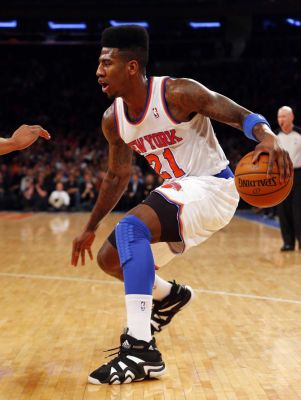
Shumpert has been back since January, but has yet to return to his rookie form


Fast forward to February when Rose’s brother and manager, Reggie, insinuated that Derrick wasn’t back playing because of the Bulls’ inactivity in the free agent market. Add to that the fact that Derrick’s agent (former Bulls’ player and executive BJ Armstrong) has a bit of a contentious relationship with the organization, and suddenly the unshakable support had come undone.  In game 2, Joakim Noah played on one foot through his own injury, to lead the Bulls to a win that evened the series and gave homecourt advantage to Chicago.

Rose has been a great player for the Bulls and even with him at full strength the odds that they would beat the Heat and represent the East in the NBA Finals are long.  Still, as long as he sits in those well-tailored suits and not in his snug jersey, there will be contention.  In his defense, if this dilemma to play has shown the star (and players at large) is that there is no loyalty in sports; not even from the fans. 

Amongst my generation that grew up with free agency as common place, the love for the name on the front of the jersey will always supersede the love for the name that adorns the back.  When players can leave at the drop of a hat (or more likely, production) it is a defense mechanism to protect our hearts and distance ourselves from players.  Let’s just hope that this hasn’t jaded us too badly, and gives Rose the time he feels he needs to recover.

Wednesday, April 24, 2013

Golden State Rolls Despite David Lee's injury

The star of the show poured in 30 points and 13 assists


With David Lee out, there was a lot of speculation as to how second-year coach Mark Jackson would respond.  Many thought that Carl Landry would replace Lee given their somewhat similar skill sets.  Both play the power forward position and are capable of rebounding and knocking down the 15/16 foot jumpshot with some regularity.  Lee is a better playmaker for his teammates, but Landry has proven to be a legitimate replacement.  Jackson, instead, opted to shift everyone down a position.  Rookie Harrison Barnes started at 4 (instead of his usual small forward position), Klay Thompson slid to the 3, Steph Curry to off guard, and Jarrett Jack started at point.  By going small, the spacing improved with having a 3 point shooter at the power forward position. 

The up and down pace established in the first game continued to serve both teams well in the second installment.   Andre Iguodola started the game 5/5, with 12 of the Nuggets first 22 points. The Warriors responded back with a peppering of jumpshots from multiple sources (including several from usual reserve Jack). In fitting fashion, the hometeam finished the quarter up 28-26 in a battle of “whoever has the ball last will win” basketball.

In the 2nd quarter the pace continued to fit the desires of both teams.  Neither team seemed too concerned with the idea of defense.  Transition buckets were there to be had and the squads took full advantage.  Curry finally started the game well, making up for his poor start in game 1 (his first playoff game of his career) and had 17 in the 1st half.  A couple of empty possessions from the Nuggets due to turnovers and the Golden State lead ballooned to 10 points. Despite Lawson’s 13 first half points and 7 assists, the Warriors finished the half up 61-53.


 The quick-strike offense continued in the 3rd.  In the first minute Curry hit a long jumper, dished to Klay in transition for a three, and found Barnes for another 3 point hoop.  That series of plays blew the game open early in the 2nd half.  The most intriguing thing about this series is that (because of the offensive potency, fast pace, and lackluster defenders) no lead is safe.

Rookie Harrison Barnes was sensational, adding in 24 points from the PF posiotion


In order to slow down the Nuggets scoring and their paint touches (a point of emphasis for Geroge Karl is that he wants at least once in every possession for the ball to be in the paint) the Warriors switched to a 3-2 zone. The Nuggets still had success against the zone because of late backline rotations and cavernous passing lanes.  Another issue that presented itself for the Warriors was Curry tweaking his left ankle.  Curry was able to stay out of the game as the Warriors spread the scoring wealth with Thompson and Barnes scoring from outside and in transition.  At the end of 3 quarters, the Warriors had put up 96 points on 63% shooting from the field (and an insane 65% from 3).

Despite the crazy shooting pace, Denver remained within shouting distance of the Warriors; in no small part due to the Nuggets bench.  Led by Andre Miller and Corey Brewer, the Nuggets bench finished with 62 points.

The most beautiful thing about Curry’s dominating performance may have been his assists (13).  When Denver began to trap him, he passed to the hard rolling big. When he was in the open floor, he found the teammate in transition sprinting to the three point line.  His facilitating helped every Warriors player shoot 50% from the field, and the team cruised to a 131-117 victory.

The Warriors adjusted due to injury.  It will be up to the Nuggets to tighten the screws on defense, because they shot better than they normally do and still lost by 14.  As Faried rounds back into shape, it’ll be interesting to see how much of a factor he will be, given that he may have to be matched up against Barnes—presenting matchup problems for both.  Regardless of the chess match of the two coaches, this will continue to be the most entertaining (if not competitive) series of the 1st round. 

Tuesday, April 23, 2013

Bucks vs Heat: Game 2 recap

Was there ever a doubt?


This game started off about as wacky and backwards as it could have.  The Heat (usually a very good ball-handling team) committed several turnovers that led to more possessions for the Bucks.  Milwaukee’s scoring backcourt of Monta Ellis and Brandon Jennings couldn’t buy a basket in the first half—seriously, they didn’t score one field goal (0/7) the entire 1st half of the game. They did, however, assist on 8 baskets as the frontcourt players attacked relentlessly.  Mike Dunleavy, Larry Sanders, Marquis Daniels and Luc Mbah a Moute all shot and rebounded well enough to keep the Bucks in the game.  Combine that with the 2/9 3 pt shooting that plagued the defending champions in the first half, and you get the 47-43 Heat lead.

While some things were quirky, LeBron James’ production was as regular and phenomenal as ever. 15 points and a few assists were efficiently garnered on 5/6 shots in 18 minutes.  The second half brought more of the same from Ellis and Jennings, both continued to facilitate and struggle with their own shot (Ellis finally broke the basket-less streak with a transition layup with 8:24 left in the quarter).  But their ability to draw a crowd on the pick and roll allowed Sanders more room to cut to the basket and amass his points at the rim.

Not to be outdone by the opposing frontcourt player, Chris Bosh began to show his teeth on offense with some drives and jumpers in the lane.  Dwyane Wade was similarly offensive minded with a series of highlight plays including this one.   Still, missed shots and turnovers allowed Milwaukee to stay in the game and to get into transition.  The Bucks finished the 3rd Quarter on a 5-0 streak and within 3 points with a score of 65-68.

In the first minute and a half the Heat showed what they have shown all year: The ability to turn up.  Defensively they blocked shots, played passing lanes, and had a 12-0 run in the blink of an eye that stretched the lead to 15 before Bucks coach Jim Boylan was forced to call a timeout with 9:37 remaining in the game.  Suddenly the Bucks going 0/2 with two turnovers put them out of the game.  After that, the game was essentially over. LeBron and Wade closed the show and retained the homecourt advantage for the Heat.

Interestingly, John Henson (who plays a similar role to Sanders with his ability to protect the cup and dive to the basket) got virtually no time in the second game.  While I can understand not wanting too many bigs on the court clogging the lane and preventing Jennings and Ellis from driving, Henson has the lateral quickness to switch on Pick and Rolls that are the staple of Miami’s offense.  Combine that with the fact that adding a quality rebounder like Henson against the worst rebounding team in the league, and his ability to protect the cup with his shot blocking, and it seems like there would be a place for the former Tar Heel in the rotation.

No one is under any illusions about the Bucks’ chances to win the series; hell, you may have trouble finding a bet that they’d win a game.  But getting the young core legitimate time could be invaluable moving forward for them and the franchise. 

Grizzlies vs Clippers: A fight for Philosophy

Clippers PG (and NC native) putting the finishing touches on his masterpiece


The Clippers continued their effective scoring as soon as the game started.  The pace was up and down and featured dunks by Blake Griffin (who scored 11 points in the 1st, one more point than his total in game 1) and DeAndre Jordan.  The Grizzlies, however, responded well with their own quick-hitting offense that was opportunistic in transition.  Mike Conley took the reigns of the offense and was more aggressive getting the team in their offense more quickly than in the previous game.  Moreover, Conley looked for his own shot more in addition to finding teammates (he sparkled, scoring 28 points and adding 9 assists).

The 2nd quarter produced more of the same, with both teams shooting well.  By the end of the half though, the Grizzlies began to revert to their less effective halfcourt offense as Zach Randolph continued to struggle with the athleticism and length of the Clippers front line.  The team relied on Conley for the bulk of its perimeter scoring, and buffered that with Gasol to stay within shouting distance.  At the end of the half, the Clippers held a six point lead. Their lead was built in no small part to Jamal Crawford going full-on Super Saiyan.

All game it felt as if the Clippers should be ahead by more points.  The Clippers filled the game with its classic show-stopping hijinx.  There were plenty of times when the Grizzlies simply looked outgunned by an offensively superior team.  Yet, the Grizzlies kept clawing their way back into the game.  The cat and mouse game looked to come to a close early in the 4th Quarter as the Clippers took a 12 point lead with 3:47 to play. With Zach Randolph on the bench in foul trouble Darrell Arthur answered the call and (along with Conley) helped string together a 9-2 run that tied the game with 1:37 left to play.  The Clippers had hit a lull.  Despite all of its offensive success, their halfcourt offense deteriorated into long jumpshots that led to immediate defensive rebounds and allowed the Grizz to get back in a game that looked to be out of their reach most of the final period.

Zach Randolph has been in foul trouble all series trying to slow down Griffin

The dueling point guards traded baskets and plays as Chris Paul pulled his “closer” cape out with his own series of isolation plays (going 3 out of 4 from the field to close the game).  The best player on the court, fittingly, ended the game on this dramatic drive to the cup, a fist pump, and a nonchalant walk to his teammates.

The next game is in “The Grind House” in Memphis.  Obviously a loss would mean that (for all intents and purposes) the series would be over.  This series has been a litmus test on the mid-season Rudy Gay trade.  While their numbers (wins, defense efficiency, and offensive efficiency) have been similar to last year with Gay, the test was always going to be how they fared in the playoffs.  in the postseason it is more difficult to score because the opposition prepares more and the possessions per game drop.  Early on, the acquisition of Tayshaun Prince and company has yielded little in terms of results.  Prince has been an abysmal 3/15 over the two games, and his defense hasn't been as helpful given that the Clippers don’t have a primarily scorer he can guard.  I hope that Austin Daye (another piece of the Gay trade) will get more time and boost the anemic output of the bench.  Daye’s shooting ability from deep may give Zach Randolph and Gasol more space to operate. 

From a macrocosm outlook, it may help answer the importance of “star players” in the postseason.  Despite statistics that supported the trade (that was done to save Memphis from being over the punitive luxury tax), the classic thinking in basketball has always been that stars are better in the postseason than role players because of their ability to score when the offense breaks down.  

Bulls vs Nets: Recap of Game 2

Unsung hero was Luol Deng, who led the Bulls in points and was invaluable on defense


The Bulls and Nets game started off in the manner that Chicago needed.  After getting blown out in game 1, the offensively depleted (and injury ravaged) Bulls needed a tough, rugged, sloppy game in order to be in a position to steal the game on the road and take the homecourt advantage in the 2-3-2 format.  The Nets started the game with six turnovers and were held to 17 points in the first quarter.  Moreover, the team struggled to a 1/8 start from 3 point range.

In the 2nd quarter, the Bulls began to hit their stride offensively, sparked by their offensive backcourt of Marco Bellini and Nate Robinson.  As the pace increased, however, the Nets began to find their own offensive groove.  Their offensive push was led by their bigs, reserve Kris Humphries and Brook Lopez started a 12-3 run to tie the game at 39.  The Bulls answered with their own run of 8-2, despite Lopez’s hot shooting from 20 feet away. The Nets finished the half on a 5-0 run fueled solely by CJ Watson (including a three to end the half on a Deron Williams assist as time expired).

A 47-46 lead for Chicago was significant, if for no other reason than the Nets never trailed in the first game; that said, Williams hadn’t scored a single point.  It looked to be a perfect precursor for the 2nd half which would hypothetically feature the Nets pulling away once they got more of a contribution from their suddenly resurgent point guard.  A funny thing happened on the way to the Nets “turning it on”—the third quarter.  The Bulls doubled the Nets scoring in the third period with a 22 point outing; relatively high considering the slow pace of the game and the difficulty in scoring against the opposition’s halfcourt defense.  The Nets missed their last 11 FG attempts of the quarter and fell back into their habit of turning the ball over.  A poor showing from Joe Johnson was highlighted by several isolation plays that resulted in turnovers and poor offensive sets.

A switch in the lineup by coach PJ Carlesimo moving Johnson to the SF and CJ Watson to the two sped the team up and increased the spacing on the floor that Gerald Wallace hurt with his poor shooting ability.  The last four minutes the game was as close as it had been all game with 80-76 score. Joakim Noah simply took the contest over on both ends with a layup and multiple blocked shots (Brooklyn was 22/27 at the rim in game 1, in game 2 they were 11/25).  Noah’s quality play late was made even more amazing given his plantar fasciitis (a slight tear in the bottom of the foot) injury.

Noah attacking another loose ball. Indicative of his contribution all night.


The Bulls responded with a roar, when a whimper may have put them on the edge of being out of the series.  Game 3 will be interesting to see, if for no other reason than to observe the Nets rotation.  One of the downsides of having such a productive bench and being two deep at every position is that figuring out whom to play can be a series of difficult decisions.  Andray Blatche and CJ Watson were both helpful in getting the Nets back in the game after several empty offensive possessions, while Gerald Wallace and Reggie Evans were less effective.  The third installment of this series will tell as much about PJ Carlesimo as game 2 did about Coach Thibodeaux and his ability to rally his players coming off the blowout loss.